
Detection Quality
Detection Quality describes the quality of the signals and logic used to detect adversary behavior. It considers two complementary characteristics: robustness and precision.
Robustness considers how difficult a detection signal is for an adversary to evade or manipulate.
Precision considers how well a detection signal distinguishes malicious behavior from benign activity.
A detection can perform well in one dimension without performing well in the other. A highly specific indicator may provide strong evidence of known malicious activity but be easy for an adversary to change. Conversely, an observable tied to a system interaction that an adversary cannot easily avoid may also occur frequently during legitimate activity. Considering both provides a more complete picture of detection quality.
Balancing Robustness and Precision
Robustness and precision describe different properties of a detection, and improving one does not necessarily improve the other. A detection based on a known malicious hash, for example, may be highly specific when that value is observed. However, an adversary may be able to change the file and therefore its hash without changing the underlying behavior. The signal can provide strong confidence when it appears while remaining relatively easy to evade. At the other extreme, a detection may observe a system interaction that is required across many implementations of a technique. This can provide more durable visibility, but the interaction may also occur frequently during legitimate activity.
The strongest detection is therefore not always the most specific signal or the signal that observes the most behavior. Detection engineers should consider both characteristics and determine what combination of evidence provides useful visibility for the behavior and environment being monitored. Additional fields, conditions, or contextual information can improve the precision of a robust signal. Conversely, more durable behavioral observables can strengthen a precise but easily changed signal. See Building High-Quality Detections for guidance on applying these trade-offs during detection design.
Robustness
Robustness measures how difficult a detection signal is for an adversary to evade or manipulate.
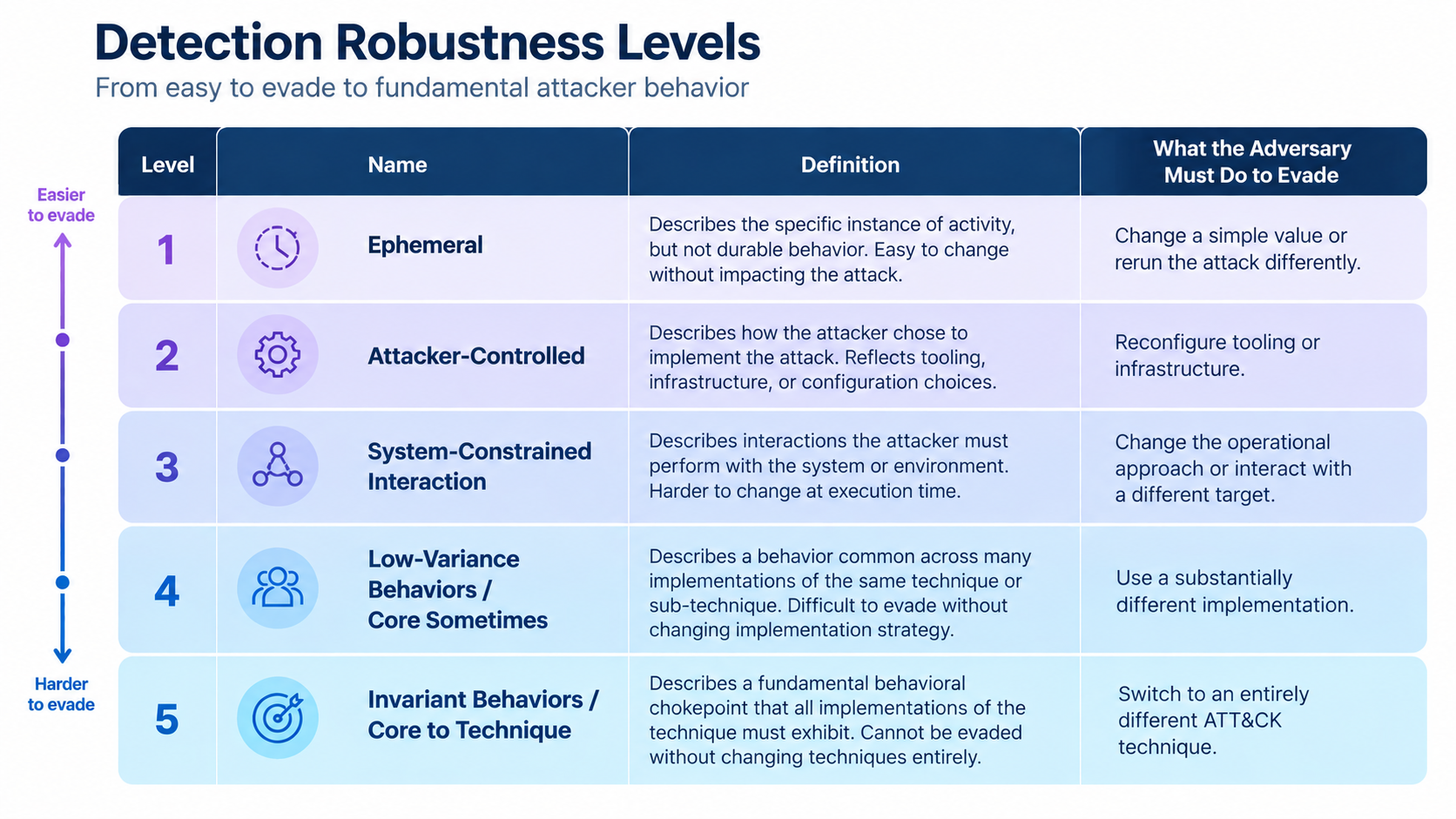
Signals based on attacker-controlled values—such as filenames, hashes, or specific command-line arguments—may be effective when those values appear but relatively inexpensive for an adversary to change. More robust detections rely on behaviors and system interactions that are increasingly difficult to avoid while still accomplishing the adversary’s objective. At the highest levels of robustness, evasion may require the adversary to substantially change how the behavior is implemented or abandon the technique altogether.
The Summiting Levels provide a framework for describing this progression. Combining Observables explains how multiple observables contribute to the robustness of a detection. For a worked example of applying the methodology to an analytic, see Scoring Detection Robustness.
Precision
Precision measures how well a detection signal distinguishes malicious behavior from benign activity.
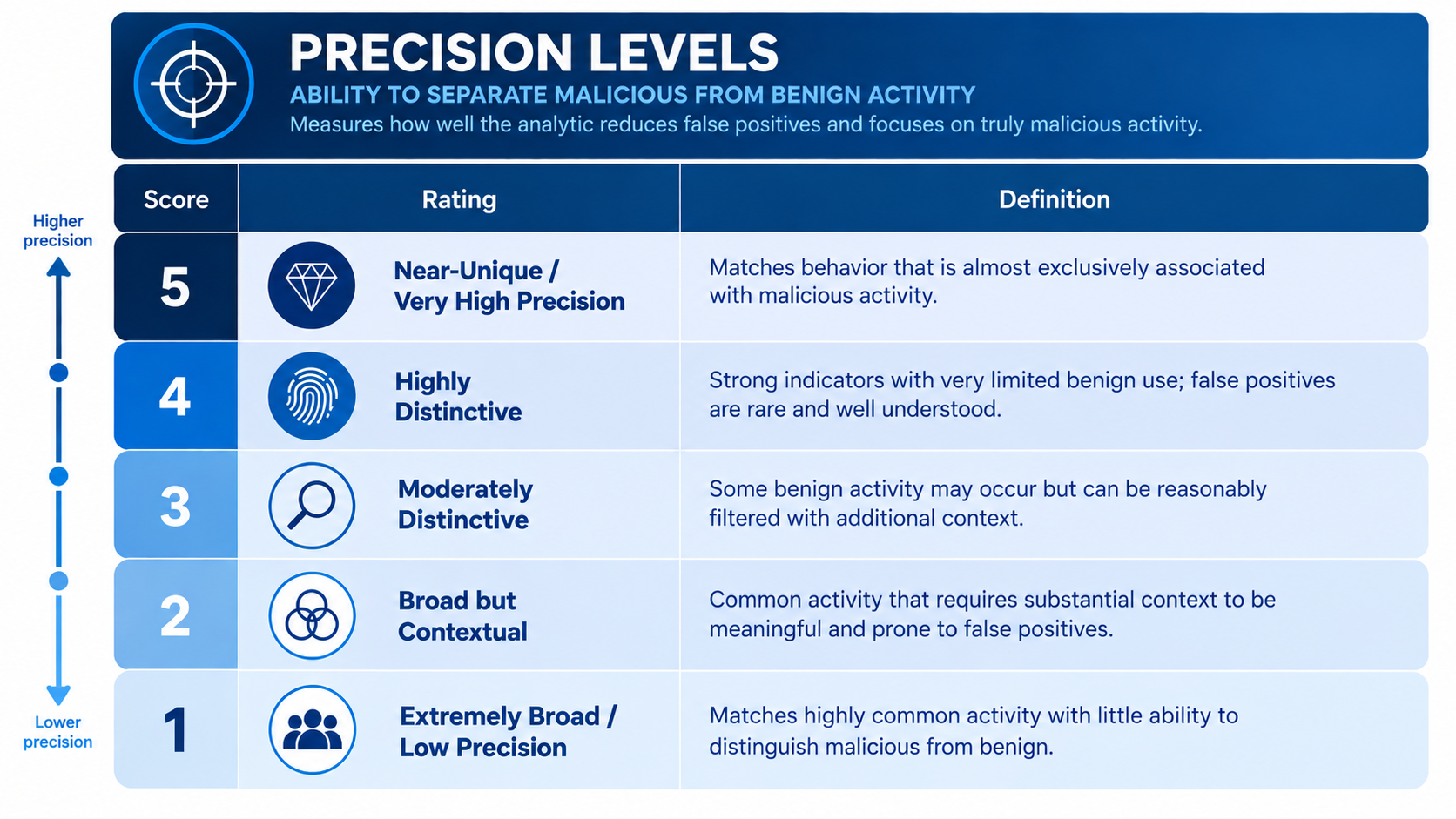
A signal can be highly robust while still providing limited information about intent. An operating system interaction required by a technique, for example, may also occur routinely during legitimate administration. Detecting the interaction provides visibility, but additional evidence may be necessary to determine whether the activity is malicious.
Precision can be improved by incorporating fields, values, conditions, or context that more specifically characterize the behavior of interest. However, increasing specificity can also narrow the behavior the analytic detects or introduce conditions an adversary can manipulate. Precision should therefore be considered alongside robustness rather than optimized independently.
Distinguishing Malicious from Benign Activity
Telemetry tells us that activity occurred; detection logic must provide enough context to determine what that activity means. An event or field alone may describe a system interaction without distinguishing legitimate use from adversary behavior. High-quality detection logic incorporates the information necessary to narrow that ambiguity and establish stronger evidence of the behavior being detected.
See Using Context to Determine Intent for guidance on incorporating contextual evidence.
Combining Evidence
A single signal does not always provide both strong robustness and strong precision. Detection logic can combine multiple pieces of evidence to improve Detection Quality. A durable behavioral observable may establish that an important system interaction occurred, while additional fields or contextual signals help determine whether that interaction is suspicious or malicious.
Filters and exclusions can similarly improve precision, but they should be evaluated for the blind spots they may create. A condition that reduces benign activity may also create an opportunity for an adversary to evade the analytic. In some cases, multiple analytics may provide a better balance than trying to make a single analytic perform every function.
See Chaining Analytics for guidance on combining multiple analytics.