
Detection Engineering Workflow
Building effective detection analytics requires more than writing a query against available telemetry. Detection engineers must understand the behavior they want to detect, identify where that behavior can be observed, select useful signals, add context where necessary, and evaluate what the resulting analytic actually covers.
The Summiting the Pyramid methodology brings these activities together into a repeatable detection engineering workflow:
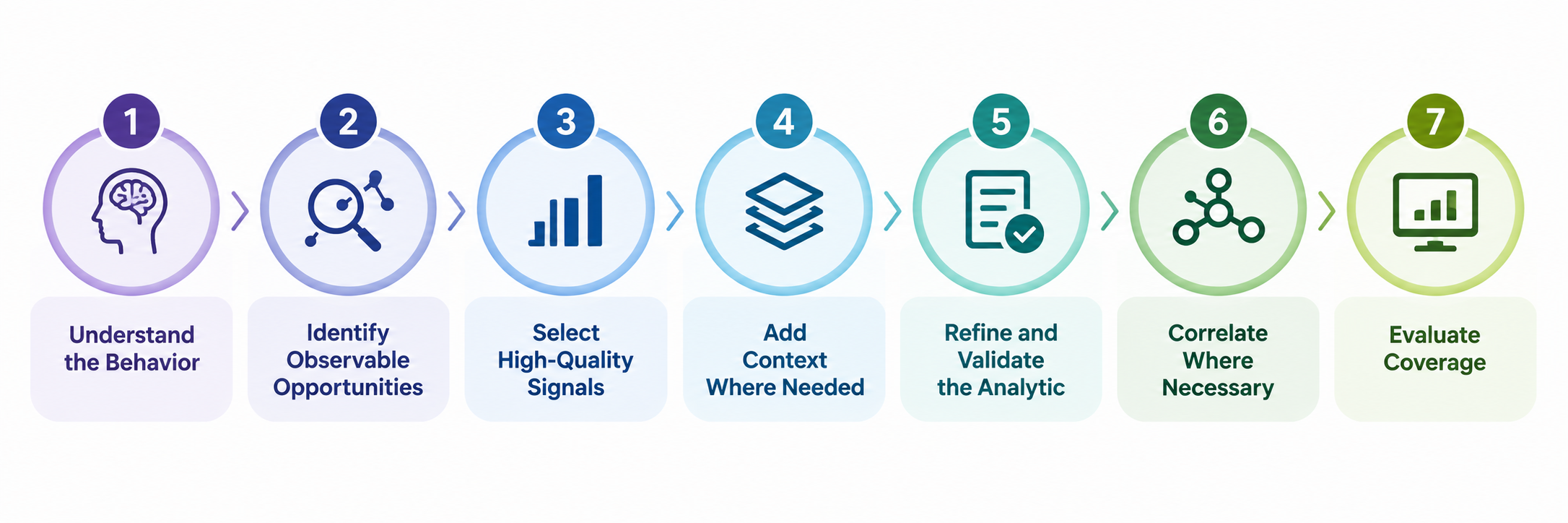
These steps are not strictly linear. Detection engineering is an iterative process, and findings at one stage may identify gaps that require revisiting an earlier decision.
1. Understand the Behavior
Start with the adversary behavior you want to detect rather than a particular tool, indicator, or analytic. Identify the ATT&CK technique or sub-technique of interest and understand the different ways the behavior can be performed. A technique may have multiple behaviorally distinct implementations, each involving different execution paths and system interactions.
At this stage, ask:
What behavior am I trying to detect?
How can an adversary accomplish it?
Which system interactions are required to perform it?
Which differences between implementations matter for detection?
Starting with behavior establishes the scope of the detection before telemetry or analytic logic constrains the problem. See Implementation Coverage and the Implementation Catalog for guidance on understanding behaviorally distinct implementations of ATT&CK techniques.
2. Identify Observable Opportunities
Once the behavior is understood, determine where evidence of that behavior can be observed. Malicious activity can produce observables at multiple layers, ranging from tool-specific artifacts to system interactions shared across several implementations. Understanding these relationships can reveal detection opportunities that are more durable than indicators associated with a single tool or execution path. The Detection Decomposition Diagram (D3) can be used to visualize significant observables across implementations and identify common detection opportunities.
Next, determine whether the necessary telemetry is available. Trace relevant system interactions to the sensors, events, and fields capable of observing them. See Field-Level Telemetry Mappings & Scoring for guidance on connecting system interactions to observable telemetry.
3. Select High-Quality Signals
From the available observables, select signals that provide meaningful evidence of the behavior and are difficult for an adversary to avoid. Do not assume that the most specific observable is necessarily the strongest one. A filename, hash, tool name, or command string may precisely identify known activity while remaining inexpensive for an adversary to change. Conversely, an observable tied to a required system interaction may provide more durable visibility but require additional context to distinguish malicious from legitimate activity.
The objective is to select and combine signals that provide useful Detection Quality while maintaining visibility across the behavior you intend to detect. See High-Quality Detection Design Principles for guidance on selecting signals and designing detection logic around behavior rather than disposable artifacts.
4. Add Context Where Needed
Some adversary behaviors cannot be reliably distinguished from legitimate activity using a single observable. When the behavior is ambiguous, determine what additional information is needed to establish intent. Useful context may come from the user performing the activity, the affected system, timing, environmental baselines, other observable fields, or surrounding activity in the attack chain.
The objective is to add enough context to distinguish the behavior of interest without unnecessarily narrowing the analytic and creating avoidable blind spots. See Using Context to Determine Intent for guidance on technique-level, chain-level, and peripheral-level context.
5. Refine and Validate
Test the analytic against representative data from the environment in which it will operate. Evaluate whether the analytic captures the intended behavior, identify legitimate activity that produces alerts, and determine whether expected malicious or emulated activity is missed.
Environmental baselines can help identify recurring benign behavior and determine where exclusions may be appropriate. When adding an exclusion, consider both its operational benefit and the blind spot it creates. Broad or easily manipulated exclusions may give an adversary an opportunity to hide otherwise detectable activity.
Prefer exclusions that:
are grounded in known benign behavior;
are as specific as practical;
rely on conditions that are difficult for an adversary to manipulate; and
have clearly understood detection trade-offs.
Validation should continue after deployment. Environments change, benign activity changes, telemetry changes, and adversaries adapt. Analytics and their exclusions should therefore be reviewed and adjusted over time. See High-Quality Detection Design Principles for additional guidance on designing detections for the environment in which they operate.
6. Correlate Where Necessary
A single analytic may not always provide enough evidence to reliably identify malicious behavior. When multiple observations collectively provide stronger evidence than any one observation alone, correlation can add the context necessary to make a more useful detection. This may involve directly correlating dependent activities associated with a known adversary or campaign, or more loosely combining behaviors that collectively increase confidence.
Correlation should be used when the relationship between observations adds meaningful information, rather than simply to increase analytic complexity. See Chaining Analytics for guidance on direct and loose correlation approaches.
7. Evaluate Coverage
Once an analytic has been developed and validated, evaluate what defensive coverage it actually provides.
Consider:
Which implementations of the mapped ATT&CK technique can the analytic detect?
How robust are the signals it relies upon?
How well do those signals distinguish the behavior of interest?
What behavior or implementations remain outside the analytic’s visibility?
Is a remaining gap caused by detection logic, telemetry, or both?
Coverage evaluation can identify opportunities to improve the analytic, collect different telemetry, develop complementary detections, or revisit the ATT&CK mapping. See Measuring Detection Coverage for guidance on Detection Quality and Implementation Coverage. The Detection Coverage Calculator can automate portions of this analysis across larger sets of detection content.
An Iterative Process
Detection engineering rarely ends after the first analytic is deployed. Coverage analysis may identify an implementation that is not observed. Validation may expose a false-positive problem. A new telemetry source may provide a stronger observable, or changes in the environment may make an existing exclusion unsafe or unnecessary; these findings should feed back into the workflow. The goal is not to create a perfect analytic in one pass, but to establish a repeatable process for refining and improving your detections.