Skip to content

Summiting The Pyramid v4.0.0

The Center for Threat-Informed Defense

Site Contents

  • Detection Engineering Work Overview
    • Summiting the Pyramid Overview
    • Ambiguous Techniques Overview
    • Definitions
    • Presentations & Publications
  • Telemetry Strategy & Readiness
    • Minimum Telemetry Requirements
    • Telemetry Confidence Scoring
  • Analytic Design & Engineering
    • Components of a Robust Detection
    • How to Build a Robust Detection
    • Detection Decomposition Diagram (D3)
    • Using Context to Determine Intent
    • Chaining Analytics
  • Detection Evaluation & Validation
    • Summiting Levels
      • Level 5: Core to Sub-Technique or Technique
      • Level 4: Core to Some Implementations of (Sub-)Technique
      • Level 3: Core to Pre-Existing Tools or Inside Boundary
      • Level 2: Core to Adversary-Brought Tool or Outside Boundary
      • Level 1: Ephemeral Values
      • Column A: Application
      • Column U: User-Mode
      • Column K: Kernel-Mode
      • Column P: Payload Visibility
      • Column H: Header Visibility
      • Observables Quick Search
    • Combining Observables
    • How to Score Resistance to Adversary Evasion Over Time
  • Examples & Use Cases
    • Example Robustness Mappings
    • Analytics Repository
      • Access Token Abuse
      • ADFind
      • Executable (EXE) File Download from a WebDAV Server
      • File Creation Date Changed to Another Year
      • Link (LNK) File Download Containing a WebDAV UNC Hyperlink
      • Remote Registry Management Using Reg Utility
      • Service Registry Permissions Weakness Check
      • Scheduled Task/Job
      • Zeek DCE-RPC MITRE BZAR Execution
      • Archive Collected Data
      • Domain Account Discovery
      • File & Directory Discovery
      • LSASS Memory
    • Use Case Telemetry Confidence Scoring
      • Automation Overview
      • C2 Over Legitimate Channels
      • Credential Access and Abuse
      • Data Exfiltration via Web/Cloud
      • Execution via Scripting Languages
      • Initial Access via Spearphishing
      • Lateral Movement
      • Abuse of Native OS Features
      • Penetration Testing Tools
      • Persistence via Registry/Startup
      • Post-Exploitation Reconnaissance
  • Changelog
  1. Docs
  2. Examples & Use Cases
  3. Analytics Repository
  4. Link (LNK) File Download Containing a WebDAV UNC Hyperlink

Link (LNK) File Download Containing a WebDAV UNC Hyperlink

Original Analytic

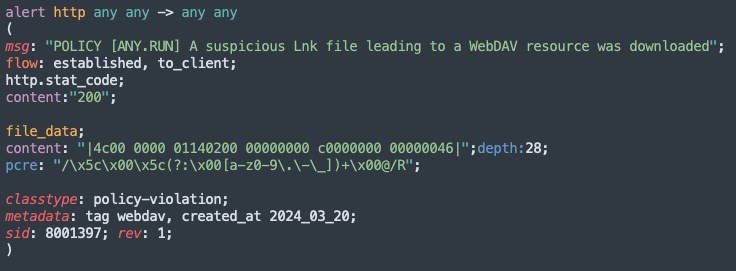
alert http any any - any any
(
msg: "POLICY [ANY.RUN] A suspicious Lnk file leading to a WebDAV resource was downloaded";
flow: established, to_client;
http.stat_code;
content:"200";

file_data;
content: "|400 0000 01140200 00000000 0000000 00000046|";depth: 28;
pcre: "/\x5c\x00\x5c(?:\x00 [a-z0-9\.\-\_])+\x00@/R";
classtype: policy-violation;
metadata: tag webdav, created_at 2024_03_20;
sid: 8001397; rev: 1;
)

Analyic Source: ANY.RUN
Original Analytic Scoring

Payload (P)

Header (H)

Core to (Sub-) Technique (5)

Core to Part of (Sub-) Technique (4)

Payload|beginswith: “4C 00 00 00 01 14 02 00 00 00 00 00 C0 00 00 00 00 00 00 46” and
Regex pattern: “x5Cx00x5C(?:x00[a-z0-9.-_])+x))@”

Core to Pre-Existing Tool or Inside Boundary (3)

Core to Adversary-Brought Tool or Outside Boundary (2)

Ephemeral (1)

The Suricata rule looks for the 20-byte sequence 4C 00 00 00 01 14 02 00 00 00 00 00 C0 00 00 00 00 00 00 46 at the start of the file, and a regular expression (regex) pattern to match double-backslash \\ followed by an arbitrary-length series of lowercase letters, digits, periods, dashes, and underscore characters followed by the @ symbol. According to Microsoft documentation, the first 4 bytes of an LNK file must equal the hexadecimal value 0x0000004C, and the next 16 bytes must equal the Shell Link Class ID 00021401-0000-0000-C000-000000000046. [1] Therefore, the 20-byte sequence in this Suricata rule is robust enough to specifically identify LNK files, and this observable would have an analytic robustness score of Level 4: Core to Some Implementations of (Sub-)Technique. Furthermore, the regex pattern for the WebDAV UNC path is general enough to allow either an IP address or a host/domain name followed by the @ symbol. The analytic robustness of the regex pattern is also Level 4: Core to Some Implementations of (Sub-)Technique. The event robustness is Column P: Payload Visibility, because it relies on visibility of the HTTP body section, and the overall robustness score for this rule is 4P.

References

[1]

https://learn.microsoft.com/en-us/openspecs/windows_protocols/ms-shllink/16cb4ca1-9339-4d0c-a68d-bf1d6cc0f943

← File Creation Date Changed to Another Year Remote Registry Management Using Reg Utility  →

On This Page

  • Link (LNK) File Download Containing a WebDAV UNC Hyperlink
    • Original Analytic
    • Original Analytic Scoring

The Center for Threat-Informed Defense

The Center for Threat-Informed Defense is a non-profit, privately funded research and development organization. Our mission is to advance the state of the art and the state of the practice in threat-informed defense globally.

The Center for Threat-Informed Defense

Related Sites

MITRE INFORM Sensor Mappings To ATT&CK

© 2023, 2024, 2025, 2026 MITRE. Approved for public release. Document number(s) CT0078, CT0128, 25-1550, 26-0334.